Monday, September 30, 2013

Drilling Beneath My Feet

Ratatataratatatratatat. This is the amazingly loud noise coming from beneath my feet. They are cleaning the ballast tanks on Deck 2, one deck below me. The particular tank that they are cleaning right now happens to be right below my room.
Cleaning the tanks involves the use of needle guns. They hammer away at the rust in the tanks, making one very loud racket that causes my floor to tremble as the metal in the tanks vibrates. I try to stay out of the room as much as possible during the day, while the drilling is taking place.
Heaven help the poor night shift workers that are in the rooms near mine. Most of them seek out friends who are in other areas of the ship, who will let them sleep in their rooms during the day. Sleeping through the sound of the needle guns is impossible for all but the soundest of sleepers. I hope that they finish working before I am scheduled to work night shifts, or I too will be seeking other accommodations.
Engineers hard at work needle gunning in the ballast tanks

Saturday, September 28, 2013

A Day on the Kouilou River

On Saturday I was blessed with the unexpected opportunity to go on trip up the Kouilou River. That morning we left the ship with sunscreen and bugspray, packed lunches, and plenty of water. After negotiating with a driver to take us out to the river and wait for us for the very reasonable cost of 16,000CFA (approximately $32), the seven of us piled into a six person taxi. The forty-five minute ride was cozy with all of us crammed together, but I enjoyed it.
We arrived in a small village market beneath the bridge that crossed over the river. We had been there only minutes before our guide Boris found us. Seven white girls in a Congolese village do stand out just a bit, in case you didn't know. Boris led us through the village to where several dugout canoes lined the riverbank. Boris left briefly to get more gasoline for his outboard motor, and then we all loaded into the canoe.
Ready for a day on the Kouilou River
The trip was beautiful from the very start. The day started out slightly overcast, but as we went on it became a beautiful sunny day. The jungle reached all the way to the riverbank, the trees leaning out over the river, branches dipping into the water. From within the trees I could hear the sound of insects, a constant creeee creeee that was so loud that I thought there must have been thousands of them.  
We motored up the river for a couple of hours, calling out "Mbote" and "Bonjour" to all the villages that we passed. As we passed one village, we were invited to stop. We did so, and the women and children were so excited to welcome us into their village. They walked us through their village and showed us trees with cocoa pods in them. They cut a pod down for us and encouraged us to taste. The cocoa beans within the pod were covered in a soft, white flesh, and the women showed us how to suck on the beans until all of the flesh, which was mildly sweet, was gone and then spit out the bean. Then they took us further and showed us where they were clearing the jungle to make room to plant more sugar cane. Then they showed us where they were growing sugar cane. They had already harvested some and demonstrated how to remove the hard outer skin and chew on the sweet inner pulp until all of the juice was gone.
Sweet village boys
Yes, that is a knife he is holding
Village children waving Hello
They were so generous, and even gave us five sugar cane stalks to take with us. I felt so blessed by their hospitality. They sent us away, waving and calling their goodbyes. We continued up the river and around the island used as a chimpanzee refuge, then back down the river to where we had started. Our faithful taxi driver was there waiting for us, and after paying Boris and giving him two of the sugar cane stalks as a gift, we drove back to Pointe-Noire. It was such a wonderful afternoon and I hope to repeat the trip again in the future.

Monday, September 23, 2013

The Joy and the Sorrow: Lessons in Love

The Entire Nursing Staff at the Beginning of the Congo Field Service
The first few weeks of surgery. It was amazing to me to see the hospital suddenly burst into life. We went from quiet empty hallways and empty beds, to hallways teaming with life and activity and beds full of patients in just a matter of days. It was wonderful to see those first patients, to see the joy that they held. It made me smile to see them come, nervous but excited.

Though the first weeks were filled with amazing surgeries and promises of hope, there were also many patients to whom we had to give bad news. Patients whose tumors were revealed to be inoperable when they came in for their scans. Patients whose tumors turned out to be cancerous. Patients to whom we had to say, "I am sorry, but there is nothing that we can do." Of course, we would never simply turn these patients away. Those who are dying are placed in our palliative care program, and we will continue to care for them.

Two patients from my first week stand out in my mind more than any others. The first is Emmanoel, the little boy who was rushed through the line at screening day, with a tumor in his mouth and throat, cutting of his airway. Every breath was made with effort, his chest was concaved and deformed from the effort it took to simply get enough air to survive. He received his surgery in the first week. His tumor was removed successfully and after only one day on a ventilator he was breathing on his own. His parents were so thankful and excited to see how well he was doing, and asked if he would now be able to learn how to speak, something that he had never done before. The joy on their faces when they learned that he should learn how to speak normally now that he could breathe was wonderful to behold. He was sent home last week, a much happier and healthier little boy.


Emmanoel Serious and Struggling to Breathe at Screening Day
Emmanoel Happy and Healthy after Surgery
The second child was a little girl, the same age as Emmanoel, and with the exact same problem. A tumor was filling her mouth and throat, cutting off her airway, so that she could barely breathe. She was also admitted to the hospital in the first days after the hospital opened. Her story however, did not end happily. Her tumor was found to be cancerous and inoperable. In the few days since screening day, her tumor had grown measurably. There was nothing that we could do. Her mother wept when we told her. We kept her in the hospital for a few days. I was not on the ward the day she went home to heaven, but I heard of it later and wept. She had passed away in the arms of one of our nurses. She had taken one final breath, and then the tumor closed off her airway, and she breathed no more. The entire hospital mourned her loss that day.

It was a vivid reminder to me that we are not here only for the people that we can help, the people we can heal, the people that we can "fix". We are here for each and every person that we will interact with: our patients, their families, and every other person that we will interact with here in Congo. We are here to share the love of Jesus in whatever way we can, by caring for each and every patient with kindness, by comforting the grieving, and rejoicing with those who are healed, by giving a smile and a gentle touch. This is why we are here, not just to provide surgeries, not just to bring physical healing, but to heal with love, to heal the wounds that cannot be seen. .

Friday, September 6, 2013

My Precious Little One

My first shift. I can't tell you how exciting it was to get my schedule and see on that spreadsheet my name, and work schedule. After two months working in housekeeping, and then two weeks of cleaning and putting the hospital together and orienting the new nurses, I can finally be a "real" nurse again, taking care of my patients.
On my time off I have been going to a local orphanage, called Mvou Mvou Baby Creche. I have fallen in love with the babies there. Many of the babies are malnourished when they reach the orphanage, and the staff are working to get them back to a healthy weight. One particular little boy has caught my heart. Malachi is fourteen months old, with limbs as thin as twigs. His body is not digesting his food the way it should. Though the orphanage staff has been feeding him well, he continues to lose weight. He has been placed on the infant feeding program through the ship, and we have provided the orphanage with a special formula that is predigested, in the hopes that his body will be able to absorb the needed nutrition. He is the length of an average 3 month old infant, and weighs only 3kg. For those of you who are not familiar with metric measurements, this comes to 6.6lbs, the size of a small newborn. His skin clings to his skull and his eyes fill up his face, old and wise like an old man. When I hold him I can feel every bone and angle of his little body. He is so lethargic and hardly moves, and when he cries there are no tears, but his little hands have hold of my heart. I pray that in the time that I spend here in Congo I will see him heal and grow to be a healthy toddler.
My Precious Little Malachi

Thursday, August 29, 2013

Patient Selection Day ~ Tears and Joy

Screening Day. That important day at the beginning of every field service when we select the first patients that we think we will be able to help. That day was today. On this day, for the first time, we meet our patients.
It is hard to put today into words. I woke early. I was not in the first group to leave the ship for the screening site, but I still had to be up at the break of day. At 0530 I was getting up and getting dressed. By 0600 I was in the dining room eating a breakfast prepared by the amazing galley team. They must have been up at 0300 in order to have those homemade doughnuts, oatmeal, hard boiled eggs, cereals, and the like set out and ready for those of us who would spend our day off the ship.  At 0630 I was at the meeting point for my team, and at 0645 we were driving out of the port gate and on our way to the selection site. You could tell the day was special. As we drove along, people would see the Mercy Ship's rover and start calling out to us, "Mercy Ships, Mercy Ships!"


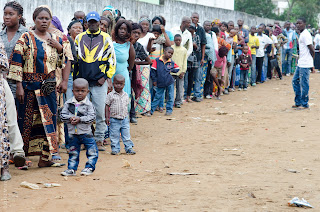

As we pulled up to the site we could see the line stretching down one side street and out of site. There were so many taxis arriving full of more people just arriving to get into line, that we could barely get through to get into the school's back gate. We entered through a back entrance to the school and immediately headed for the building that we had been assigned to. I was partnered with Katie. Our job would be to draw blood on the patients who made it through the initial screening that the surgeons wanted immediate testing on. Mostly these would be the patients with large facial tumors. The room that Katie and I were assigned to also had the biopsy team and the physical exam team. This meant that I saw every patient who was being considered for surgery for maxillofacial or plastic surgery as they came through for their exam, and later if indicated, a blood draw from me or Katie, or a biopsy by Dr. Sheffield at the table next to me.
Katie Drawing Blood

Drawing Blood on a Patient

Dr. Sheffield Looking at a Biopsy

Our room was on the second floor, and overlooked the courtyard and the gate where the patients entered . Practically speaking this meant that I could watch as each person who stood in line outside the gates came in and was directed to the right or straight ahead. Straight meant hope, the people who were guided that way were those that the pre-screening team thought we might be able to help.

My heart broke for those that I saw directed to the right. These were the ones we knew we could not help, children with obvious down syndrome, cerebral palsy, or other problems that were either inoperable, or required surgery or other medical care that Mercy Ships cannot provide. After standing in line for hours, many of them having gotten in line the night before, they had to be told that there was nothing that we could do to help them, and were guided to another building where another team member would pray with them before we sent them home.

Many of us shed tears over those we had to turn away. Though I was not involved in the selection process myself, and did not have the very difficult task of telling people "I'm sorry, but we cannot help you.", I too shed tears for the many people who left disappointed. For me the final crack that broke the dam holding back my tears was the sight of Mercy Ships financial director John Wall as he took a young girl with cerebral palsy who had been carried through the line all day on her mother's back, and carried her through the "No" line to the prayer team to give her mother a break. 


Though we shed tears, we also smiled with joy. We saw so many that we know we can help. For one little boy named Emmanoel, that help will come just in time. He was rushed from the screening line to see the doctors. He could barely breathe, the back of his throat filled with a large tumor. If he was laid back or the position of his neck was changed, he could not breathe at all. He sat stiffly, always holding his head in the position that best allowed him to breathe. Still, every breath was agonal, and could be heard from across the room. He was lethargic, every ounce of energy he had going into taking that next breath. He will have surgery next week, he cannot wait any longer. He does not have that kind of time. When I felt like weeping for those we had to turn away, I remembered that boy. I remembered the ones that we told "Yes", and I rejoiced to know that while we cannot help every person who comes, we can help this one and many others.
The day was long. They closed the end of the line around 1530, but it took at least four more hours to process those who were still patiently waiting in line. The school had no electricity, but as the day turned into evening and the light faded away, flashlights were pulled out and the work continued until every person in line had been seen.

According to Mercy Ships these are the final statistics for the day:
  • The line was open for 12 hours and 20 minutes.
  • Approximately 7000 people stood in line in the hopes of receiving treatment.
  • Of those 7000 hopeful, 4236 received cards for appointments for surgery or further tests.
  • At the peak of our busy day 311 Mercy Ships crew were present at the school to help with the screening
  • In total 345 Mercy Ships crewmembers came to help with screening day.
These are just numbers, and my words are not nearly good enough to express what it was to live this day.